 In a workshop the other day, 2130 Partners’ co-founder, Suzanne Frindt, (who is also my wife), usedthe term “Lazy Labels” to capture the instant, automatic, and unexamined statements many, if not all of us make on a fairly regular basis. These statements could also be called “knee jerk reactions.” In this highly charged season of political sound-bites, such Lazy Labels seem to be flying everywhere! What we notice about “Lazy Labels” is that they seem to be a convenient way to suppress complex topics you don’t actually understand, don’t want to examine, or have “already made up your mind about.” The issue with this is that their use diminishes your effectiveness as a vision-focused leader. Let me explain.
Lazy Labels often have the effect of “shutting things down” like diagloue and conversations. If you stop dialogue, healthy inquiry, and curiosity-based listening with one of those quick labels/statements, you and those around you, will never learn more about each others’ knowledge, perspectives and feelings. In fact your brain has a mechanism to be sure you don’t learn anything that disagrees with your Lazy Label. You won’t be learning anything new about the subject at all. You will only see evidence that agrees with you. As we have written about often, we believe this is the era of collaborative leadership. We need each other’s skills, competencies, knowledge and perspective now more than ever, so shutting yourself and/or your team members down is dangerous.
In a workshop the other day, 2130 Partners’ co-founder, Suzanne Frindt, (who is also my wife), usedthe term “Lazy Labels” to capture the instant, automatic, and unexamined statements many, if not all of us make on a fairly regular basis. These statements could also be called “knee jerk reactions.” In this highly charged season of political sound-bites, such Lazy Labels seem to be flying everywhere! What we notice about “Lazy Labels” is that they seem to be a convenient way to suppress complex topics you don’t actually understand, don’t want to examine, or have “already made up your mind about.” The issue with this is that their use diminishes your effectiveness as a vision-focused leader. Let me explain.
Lazy Labels often have the effect of “shutting things down” like diagloue and conversations. If you stop dialogue, healthy inquiry, and curiosity-based listening with one of those quick labels/statements, you and those around you, will never learn more about each others’ knowledge, perspectives and feelings. In fact your brain has a mechanism to be sure you don’t learn anything that disagrees with your Lazy Label. You won’t be learning anything new about the subject at all. You will only see evidence that agrees with you. As we have written about often, we believe this is the era of collaborative leadership. We need each other’s skills, competencies, knowledge and perspective now more than ever, so shutting yourself and/or your team members down is dangerous.

Scotoma example
Lou Tice of The Pacific Institute in Seattle, WA teaches about “scotomas“ which are our blindness to data that doesn’t match our beliefs about the world. (Scotomas are literally an area of diminished vision within the visual field, a blind spot. It comes from the Greek word skotos (to darken) and means a spot on the visual field in which vision is absent or deficient.) What we are talking about here are “mental scotomas,” meaning a figurative blind spot in a person’s psychological awareness, the person being unable to gain insight into or to understand their mental problems; lack of insight. There are many great examples of how we can’t see things right in front of us that we are not open to. A common example is when you get a new car and then suddenly see similar models everywhere. Where were they yesterday?
I am going to suggest that the scotomas created by your Lazy Labels protect you from the discomfort or flat out fear of stepping into the unknown. After all, if you drop the Lazy Label and actually engage in a real dialogue about a subject with someoone, you may hear things that may make you uncertain, uncomfortable, or downright scared. If you open up to, and actually consider ideas, perspectives, and data that differ from your previous ideas, you will be in unknown territory. You may even be permanently changed by the interaction.
If that happens, you might find yourself in a complex web of relationships and agreements built on who you were and how you thought before you opened up in this new dimension. Before you even get the chance to find your new footing you will have to get to work in new conversations with many people. You might even run into resistance, mocking or rejection. (No one ever said leadership growth would be easy…)
Even if you believe you are more evolved than I am describing, what about the folks that work with and for you? Are you getting a sense of how some of your great ideas for change may land with some of them at times? Do members of your team react to you with Lazy Labels?
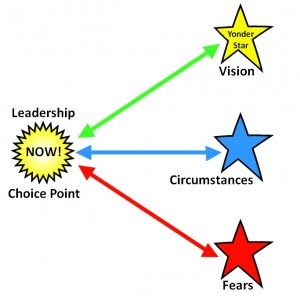
We have posted on a number of occasions about being present, being with the unknown (courage), and making the choice to work from a shared Yonder Star, (or shared vision). In a recent post we looked at the assertion that “anything you can’t be with owns your life.” Now we are upping that challenge. We are asking you to look newly under your Lazy Labels when you hear them come out of your mouth and encourage those around you to do the same.
If you are willing to get serious about kicking yourself into a new learning orbit, start making lists of Lazy Labels you have for family members, people and programs at work, “the government,” community servants, religious groups, scientific data and theories, etc., etc. Engage with and learn from people on the other side of those Lazy Labels. Be intentionally slow to understand. In this era of “faster, faster, faster’ it will be a challenge, but it will be worth it.
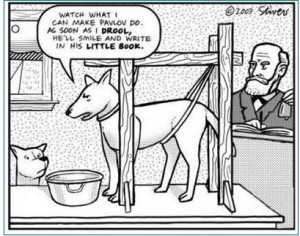 In the 1920s Ivan Pavlov conducted a series of very famous experiments in which he taught dogs to salivate at the ringing of a bell. If PDAs had been invented, he could have taught the dog to salivate when his cell phone received a call, email or text. He might have even taught the dog to bark so he would never miss an “incoming!”



 As we discuss comfort zones, set points, etc. we want to be clear that this is not a piece about people who plod along and move slowly or people who seem risk averse. If you are a fast-paced, “go go go” type of person that is your comfort zone. What if you had to slow down, be more reflective, bring your energy “down and in” instead of being an “up and out” kind of person? What if you had to take on a meditation practice? Would you still be in your comfort zone? What if you are a thrill seeker and look for ways to “push the envelope” all the time? What would happen if you lived a more mundane existence and had to experience the ordinary? Would you still be in your comfort zone?


 Many business owners, entrepreneurs, and professionals are “visionaries” – independent minded self-starters with lots of creativity and ideas. They often have a deep belief and confidence in their own point-of-view. If you are one of these people and have been successful, these traits have served you well. The challenge is that, at some point, to increase your level of productivity and success, it will take a team around you.
“My Team Are My Hands and Feet.” – Do you hire people as extensions of yourself? Meaning, you want them to just execute what you have in mind without questions - just to be an “extra pair of hands and feet.” If you have not developed the ability to clearly articulate your vision and goals in a way that is inclusive, everyone else is left wondering and waiting for you next set of instructions. This reinforces your sense of “I should just do it myself,” or, “if I could just do it myself.”
Many business owners, entrepreneurs, and professionals are “visionaries” – independent minded self-starters with lots of creativity and ideas. They often have a deep belief and confidence in their own point-of-view. If you are one of these people and have been successful, these traits have served you well. The challenge is that, at some point, to increase your level of productivity and success, it will take a team around you.
“My Team Are My Hands and Feet.” – Do you hire people as extensions of yourself? Meaning, you want them to just execute what you have in mind without questions - just to be an “extra pair of hands and feet.” If you have not developed the ability to clearly articulate your vision and goals in a way that is inclusive, everyone else is left wondering and waiting for you next set of instructions. This reinforces your sense of “I should just do it myself,” or, “if I could just do it myself.” “What Are You Really Good At?” – No matter how gifted, talented, and intelligent you are, you still have a “zone of excellence,” (as author Gay Hendricks would say), and zones of competence and incompetence. Your highest and best use is your zone of excellence.
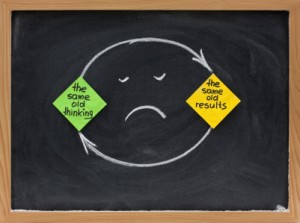
 In the process of growing up and becoming a successful leader, you most likely put together a set of well-developed values, beliefs, experiences, and capacities. You have probably done well at suppressing your emotions and demonstrating your rational thinking. Being successful means your mix has served you well; you have been rewarded, “bonused,” and encouraged along the way. You have probably learned to rely on the way you interact, solve problems, and produce results to the point where the basis of your thinking, (your “paradigm”), is now instant, automatic, and unexamined.
To paraphrase the
In the process of growing up and becoming a successful leader, you most likely put together a set of well-developed values, beliefs, experiences, and capacities. You have probably done well at suppressing your emotions and demonstrating your rational thinking. Being successful means your mix has served you well; you have been rewarded, “bonused,” and encouraged along the way. You have probably learned to rely on the way you interact, solve problems, and produce results to the point where the basis of your thinking, (your “paradigm”), is now instant, automatic, and unexamined.
To paraphrase the  leadership,” and that means the Peter Principle is “in effect.” To continue to lead successfully, you will be required to think in new ways and benefit from the thoughts and perspectives of others. In other words, cherished self-reliance becomes obsolete. Collaboration, inclusion, openness, the ability to continue learning, respect of others’ skills, expecting others to contribute - these are the traits that are critical to develop.
 This may seem like a funny question, but do you know the answer? Are you using all of your intelligence? We don’t mean “business intelligence” in the sense of consumer data, research and business results. We are talking about your own personal intelligence. You probably believe you “give it your all” and use all of your capacities and capabilities – but are you sure?
 We can all think of examples of stories where people followed a gut instinct and it was either critical to their survival, or it changed their life, or drove them to make an important business decision. When people are tuned in to that gut information, and they are asked how they knew something or why they did what they did, the response they give is, “I just knew,” and we can tell by the emphasis that the knowing came from a deep and solid place. Being able to tap into our deep-seated inner knowing is something fundamentally human that our culture does not overtly value highly.
 (This post is an edited version of an article by Suzanne Mayo Frindt. To get the complete text
  How Can We Develop a Learning Culture?
There are many books and articles about learning organizations including work by Senge
How Can We Develop a Learning Culture?
There are many books and articles about learning organizations including work by Senge In
In  If you take this on and find yourself uncomfortable, make note of what your mind is saying is going to happen to you or how your internal dialogue is criticizing you. Use your self-awareness skills and you will likely find what’s stopping you is a limiting belief. Once identified, you can go to work on letting go of it. Check out
 Fast forward back to today with this historical perspective and we can see that everything we take for granted as we do business today was originally invented by someone to facilitate trade, which in turn was driven by thousands of entrepreneurs in all regions where they were allowed to operate and were not taxed out of existence. Modern management is just a relatively late development to solve the “recent” problems of large operations scattered over great geographic areas and allow them to continue to facilitate trade and lower its cost. Much of the value of that management has been in gathering, organizing, and dispensing information needed by large numbers of people in far-flung operations to get their work done and make the transactions happen.
 Change is possible and change takes work.Whether a leader changes or not, energy is being expended. It takes energy to keep patterns in place when they aren’t working and there is a state of resistance. We call that ‘friction and waste,’ a subject we address in our blog posts on Lean Thinking. It takes energy to make changes. There is a cost either way. The question is – where does a leader “pay up?”
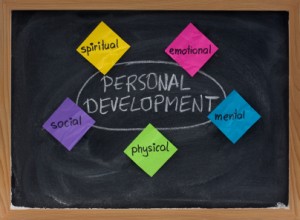
 Previously, we raised the idea that health is actually part of the larger conversation about leadership. If you aren’t at an optimum level of health you aren’t performing your best. We also raised the idea that there are multiple dimensions of health – mental, emotional, spiritual and of course, physical, (and there are even more). We wrote about the physical dimension and this week we want to go into the mental/emotional realm. These two are often collapsed together and there is no doubt they are inextricably linked. The term “mental health” often refers to our ability to handle our reactions to the circumstances and challenges that come up in our lives. In fact, the dictionary defines it as “psychological well-being and satisfactory adjustment to society and to the ordinary demands of life.” For the purposes of this post we are going to separate the two terms and define them a bit differently. When we talk about “mental health,” what we are pointing to is “intellectual health” – meaning
  how healthy and fresh are your thought processes? When was the last time you challenged yourself to learn something new? How much are you reading? (And not reports and emails! Reading fiction for fun, or non-fiction topics that interest you?) Do you do puzzles – crossword or otherwise - to stimulate your cognitive abilities? We often repeat the same thought patterns and think about the same subjects day in and day out. Learning something new helps keep your brain healthy and your perspective fresh. For more information on how to keep your brain and thinking healthy visit
  If you find you are having trouble finding your passion, designing a future you are excited about or reaching particular goals and dreams then hire a coach. Ask around and find someone who has an approach you are excited about pursuing. Partner with your coach so that you have the support you need to get where you want to go.
 There are many dimensions of health including: mental, emotional, spiritual, physical, environmental and more. It’s pretty self-evident that the healthier you are, the better you can perform. Performance is foundational to leadership yet health is rarely part of the leadership conversation. If anything, as researcher Brene Brown says, being run down from exhaustion has become a "status symbol." Although people may admire your tenacity and commitment, being exhausted is not a healthy state and it's unlikely you are performing optimally.
 er day, (8 ounce glasses that is). Yet how many of us do it? If you can just do this piece, your health will be improved simply because you will be hydrated. Don’t like plain water? Squeeze half a lemon or lime in it. Still not good? A splash of cranberry or pomegranate juice has health benefits and helps with the taste, (provided you are doing just a splash and you are doing real juice, not the high sugar filled kind.) The basics are covered in the works of Dr. Weil and Dr. Oz we mentioned above and being hydrated is one example of improving your health without feeling like you are taking hours out of your day for a huge program.